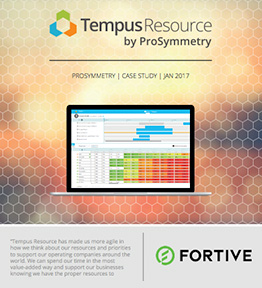
Born of global science and technology innovator Danaher Corporation, Fortive was formed in July 2016 to comprise of operating companies that are focused on creating technology-based solutions. Building on Danaher’s 30 years of success, Fortive is already a global presence and a Fortune 500 company, despite being less than a year old.
The Human Resources (HR) department is responsible for enabling the best technology for operating companies to take on HR operations in a more holistic manner. Resource management is, therefore, crucial to rolling out human capital management (HCM) and payroll for the harmonization of processes and policies for all of Fortive’s companies. Without this consistency, companies are left with different contracts with different vendors, resulting in wasted money and efficiency. As such, Leslie Kurtz—Senior Director of HR Operations at Fortive—chose Tempus Resource as their solution.
“The main challenge was obviously being able to prioritize projects through measuring the resources we had” Leslie explains. “The big corporate moniker is always ‘we need time money and resources to get things done’. But I think the resources section was never measured with math. Instead, priorities were based on emotion. The way the team used to set priorities is in meetings, we would shout out all the things we wanted to do for the year and start creating these big projects and we’d prioritize them ‘A, B, C’. But no one took into account the fact that once you’ve completed all the A’s and half the B’s you were already totally maxed out. So the challenge we had was finding a cloud-based application that could measure our team’s capacity for current and future projects.”
Leslie had attempted to resolve this issue of allocating resources systematically through Microsoft Excel, prior to discovering Tempus Resource:
“Last year, I had built something in Excel to determine the capacity gaps we had and how we could plot for different projects. So we could find out: how long will the things we want to do take and do we have the capacity to do it? But it was a laborious process. Being in Excel, it took months to fill things out and wasn’t sustainable at all. But because we found value in that initial process we said let’s look for a tool. We thought, there’s no way we are the f irst people who need something like this.”
Of course, there are a number of PPM tools available that claim to solve such issues. But, as Leslie explains, the market for such tools was different to their own. “We found quickly that the [PPM] software out there was at a much more granular level, built for complex IT organizations and assigning resources. There was a level of complexity that simply wasn’t what we were looking for; my team of HR professionals don’t have the interest or time to deal with such a complex system. So, I was beginning to get discouraged, coming to terms with the fact that we may have to pay—in the region of $100,000 per year—for a solution that was overly complex considering our needs.”
The search for the right solution took time, but Leslie’s persistence proved beneficial. “When we eventually found Tempus Resource, it was like the lights finally came on. It, in fact, mirrored the functionality I had attempted to build in Excel but was so much more elegant. It had much better reporting and far more capability” says Leslie. “It solved our problems in a simple way so those who are not IT or application-driven could go in, add a new project, enter their data regarding how long it would take and who they might need, all within 5 minutes. And this was displayed in an elegant and attractive interface; the visual representation of resources made projects perfectly clear.”
Tempus Resource—a unique suite of technology that facilitates real-time resource management and capacity planning—was closely aligned to Leslie and Fortive’s needs, enabling a higher level of efficiency, as Leslie explains:
“Everything took a lot less time. The team was able to enter in their data within the span of around 2 weeks—and that was a full portfolio for every potential project and financials. Last year, when we did it in Excel, it took me around 3 months to actually build the tool and it took everyone a lot longer to input their data. And once the data was in, any changes had to go through me as I had built summaries of individuals and teams based on the data everyone had inputted. I had to verify every change that was made, so it was extremely lengthy and tedious process. To compare, any revisions in Tempus are as simple and quick as pressing a couple buttons. The modelling feature, in particular, is a massive advantage here: we can swap in and swap out certain projects to see how it would affect people’s workloads, and that could be approved pretty much instantaneously.”
Tempus Resource also provided additional help in areas other than capacity planning. “We weren’t looking for a budget planning tool, but as it was rolled in we got an additional win. So alongside everyone putting their projects for the year in Tempus and looking at our capacity, we can attach f inancials to those projects as well. And whatever projects we approve, we can then generate our budget. It was a big win for everyone on the team to do it that way. We definitely got more out of it than we expected.”
The support given to Fortive enabled them to implement a level of resource management best practice, building on ProSymmetry’s expertise. “ProSymmetry met with us during a two-day working session to configure the whole system. They looked at my initial Excel spreadsheet in detail to understand what I was trying to do. Within a day and a half, we’d configured the entire thing and were working on building reports already. And any changes that arose were dealt with on-the-fly as we went through preparing training for the team. ProSymmetry spent a lot of time with the unique configuration of the tool, so when it came to training we had as many materials as possible and felt well prepared” says Leslie.
And that sense of preparation was felt throughout the length of Fortive and ProSymmetry’s relationship, claims Leslie. “I definitely got the feeling that everyone was very well prepared. We were not experts in the system and we were still just learning it, so ProSymmetry offered to talk one-on-one with anyone on our team to help. I thought, frankly, for the price point, that level of support was extremely cost effective. The fact that we could spend such a little amount of money compared to the other tools we were exploring prior was very good value.”
In terms of what the future holds for Fortive and ProSymmetry, Leslie believes Tempus Resource will cement itself firmly in their team and organization. “We’ll look to expand the tool as the team grows. For the time being, we will reconcile budgets every month; [Tempus Resource] will be used as an annual priority-setting exercise, but on a regular cadence we’ll be using it to manage budgets. We’ll be showing it to other functions. If there are other functions that want to apply that level of rigor to have an onboarding project process, then it can help.”
“I think there’s a lot of other functionality that we’re not quite using yet. We’ll have to see where the maturity of the organization comes into play, in particular, if I’m able to create a PMO to support all of the projects across the board. In that case, the PMO leader would be using Tempus heavily. But for now, I think it has definitely stabilized us; the team are using it with more rigor, and we’re already witnessing the return on investment.”
Named Gartner Cool Vendor 2016, Tempus Resource is a real-time resource management software that uses powerful ‘What-if’ simulations to model project data. It helps organizations of any size, of any level of project management maturity, to make risk-free, data-driven resource decisions.
Contact ProSymmetry for a free Tempus Resource trial or demo.

© 2026 ProSymmetry. All Rights Reserved.
ProSymmetry, Tempus Portfolio and Tempus Resource are registered trademarks of ProSymmetry LLC.