
Siemens Healthineers (formerly Siemens Healthcare) is a leading global medical technology company headquartered in Erlangen, Germany. As a subsidiary of Siemens AG, they enable their customers to deliver high-quality medical and patient care in the most efficient and affordable manner.
Dirk Nadler, Project Manager for Research and Development within Laboratory Diagnostics at Siemens Healthineers—whose specific job remit can be condensed to implementing resource management and getting it up and running—had the overall task to find a better way to manage Siemens Healthineers’ resources. He explains why Tempus Resource trumps countless Project Portfolio Management (PPM) tools by providing immediate visibility, getting to the heart of his company’s challenges quickly and efficiently and enabling a more effective resource management strategy.
“The problem for us before Tempus Resource was to do with ‘too many projects,” says Dirk. “No one really knew which projects everyone else was working on. The big projects were well known, but there are many, many smaller projects that are concerned with market expansions, with feature enhancements, or more simply, product health, obsolescence, and so forth. We knew enough about the 30 big projects but not the 150 smaller projects we had in the organization.”
Along with this lack of visibility, the culture and focus on the company was changing. From about 2007, Siemens Healthineers were evolving from a solely functional company into a matrix organization.
“In the old days, a project was mainly planned, managed, and run within one group. Nowadays our project teams consist of around eight functions that work a lot on these projects. We have a core team, where every representative of every function works on a project—there’s often 150 to 200 people working on these projects, working across these eight functions over a time of three to eight years to develop something,” as Dirk explains.
“There was very isolated planning in Excel sheets. Every function worked on its own—the annual budget planning, for example in isolation from the rest of the team and plans never worked together. They ended up planning with different assumptions and different goals.”
Dirk says, “That’s when I could see what the real problem here was: there was not enough collaboration, not enough transparency, and there was no system which utilizes who was working (and how much) on a project. This all needed to be brought together to foster a communication between projects and functions.”
As Dirk points out, there are many, many Project Portfolio Management tools out there but they don’t always give you the right tools when your focus is resource management.
“The problem with these tools is you introduce more problems into the organization and more change when you implement a PPM tool,” he says. “So, your organization must learn not only resource management best practice, but also project portfolio process application, plus consistent scheduling, and a much more complex tool. Which becomes just a major task.”
For Siemens Healthineers, it was down to, at first, knowing who is working on what projects and what the organization can do over the next five years. For instance, did they have the capacity for new projects? From this point of view a resource management solution was a much better choice.
“Most resource management tools are basically a by-product of a PPM tool,” Dirk says. “Even if it’s sold as a stand-alone resource management tool, you often will see some aspects of the solution that comes from a PPM tool—either from the project portfolio management view or from the project management view—and you must do things that have nothing to do with resource management because of this legacy.”
Tempus Resource, however, is a unique solution that enables real-time capacity planning and resource management.
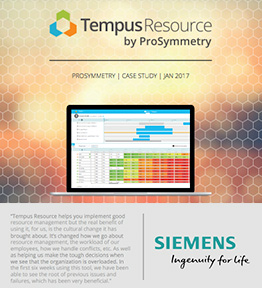
“Tempus Resource is the absolute coolest one out there,” says Dirk. “With its unique real-time simulation engine that not only looks fancy, but provides value if you go from ‘I need to know next month’s number of resources my project has available’, to, ‘let’s simulate what we can do, or what do we need to do to accomplish something. Whether it’s to execute a strategy, to execute certain projects by certain deadlines, and so forth. And that is something unique about Tempus Resource.”
For Dirk and Siemens Healthineers, the overall goal was to build a reliable three-year project road map where they could tell their CEO, “Within the next three years, with this amount of money you’ll have these projects delivered,” as Dirk points out. “Project cycle time is one metric that we are measured on, but in the end, it’s really about results. Our CEO wants to know ‘what bang for my buck do I get over the next three to five years?’ Or ‘if I develop a certain strategy will it be successful?’ That’s the question that he’s asking. This is something that Tempus Resource does very well. I haven’t seen any tool that comes close to it. My gut feeling is that we are not only reducing our project cycle time by 20 percent, if we continue the way we’re going, we will likely be able to execute, over a ten-year period, about 30 to 35 percent more projects.”
Dirk was quick to impart some good advice for companies thinking of rolling out the solution:
“You can put it into an organization in two ways: you can treat the tool as a problem-solver, put it in, don’t change anything, just move away from Excel to this central tool and don’t change the attitude to workload and how you make decisions, and so forth, and you will have more visibility and a little impact. Or you could go a couple steps further and change the culture of how you conduct your resource management and how you make decisions; build better cornerstones and a strong framework, discover how people handle certain situations and support them. If you implement like this, then the solution is going to hold real value.”
Named Gartner Cool Vendor 2016, Tempus Resource is a real-time resource management software that uses powerful ‘What-if’ simulations to model project data. It helps organizations of any size, of any level of project management maturity, to make risk-free, data-driven resource decisions.
Contact ProSymmetry for a free Tempus Resource trial or demo.

© 2026 ProSymmetry. All Rights Reserved.
ProSymmetry, Tempus Portfolio and Tempus Resource are registered trademarks of ProSymmetry LLC.