Iron Mountain Inc. is a global leader for storage and information management services, an archival and asset storage company trusted by more than 220,000 companies worldwide. Storing everything from documents and data to pieces of art, Iron Mountain help organizations lower storage costs while remaining compliant with regulations. For IT within Iron Mountain, this means developing and maintaining in-house proprietary software to keep track of it all—something used by a number of different teams at once. The process of bringing these teams together is where Iron Mountain found difficulty, and is why Tempus Resource was chosen as the solution, as Brian Richardson—Business Analysis Manager at Iron Mountain—explains.
The problem Brian and his team were facing was largely to do with unifying different teams in their organization. “IT, as is the case in multiple companies, involves a lot of departments and a lot of technical teams with different specialties. Bringing all those teams together from a resourcing perspective is challenging. Not to say that isn’t the case for marketing or sales, of course, but as an IT person, in my mind they tend to be a bit more monolithic in terms of dealing with a big pile of similar skills. In IT, we have four people over here with this skill and then another two with that skill and we have to find a way to get them to jell together on projects.”
When combined with the variety of projects across the organization, the need for effective resource management becomes even clearer. “We have about seven to eight hundred people within the IT organization working on one hundred projects. Projects tend to break down into a few different types, but they run the gamut from infrastructure projects—expanding a data center or building out environments—to transformational projects concerning cost reduction,” Brian explains.
“Also, Iron Mountain recently acquired Recall, who was previously our largest global competitor. Now they’re part of the team, we’re in the midst of all the integration activity meaning there are a large number of projects focused on that. And then we also have several internal software development teams that develop the software we use to track all of the assets we store. We have projects around enhancing, releasing and updating all of our third-party systems too, and they need to be rolled-out and maintained. It’s quite a lot to keep track of, in all honesty.”
Acknowledging challenges is only half the battle; finding the solution was the more difficult and pressing task at hand. “The primary challenge is—and I think this is what a lot of companies face—we have multiple hundreds of people doing work. There’s always a general sense that there’s too much work and not enough people. But we were never able to quantify that and plan against it all that clearly,” says Brian. “So really, our challenge was to establish a picture of what we were working on: who was working on it, when they were working on it, and how many hours did we have free to put to different projects.
“The other big challenge was around governance. We knew that the Iron Mountain organization has an appetite to do a certain quantity of work for each year ahead. The IT organization is integral to a lot of that activity, yet we simply don’t have enough people to do all the things the business wants to do. So, we have a conversation about what we can accomplish to enable our governance organization to make decisions and prioritize the work that’s most important. We needed a way to clearly and simply show our capacity for the proposed work, and whether there were areas we were over or under that capacity.
“And related to that, we needed to be able to move projects around in order to smooth the demand. That way we could understand how much work we could do throughout the year when we were having these governance conversations. And it’s really that final piece that, in my mind, is the biggest value proposition for Tempus Resource.”
Tempus Resource—a unique suite of technology that facilitates real-time resource management and capacity planning—was closely aligned with Brian and Iron Mountain’s needs, enabling a higher level of efficiency, as Brian explains:
“To be perfectly honest, anyone with a spreadsheet can add up people and time on a monthly or weekly basis and highlight where you have shortfalls. That in itself is not that difficult; I’ve built my own custom version internally before. The difficulty is when you want to change that information, or more specifically, when you want to play with ‘What-If’ scenarios.” That scenario-planning capability is what really drew Brian and Iron Mountain towards Tempus Resource.
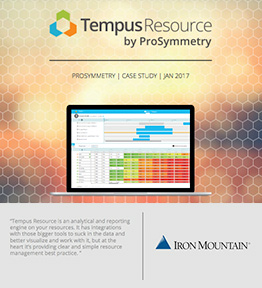
“The ability to take your mouse, click a project, drag it three months to the right and watch the heatmap update—that’s really where the value lies. It seems simple but it’s actually very powerful. Because when you are having governance conversations with senior leadership, simplicity is everything. Using bright, primary colors; having a visual representation that allows you to say ‘well we could fit it here; watch how the red turns to yellow’ in a live environment; they get it. And they get it because it’s incredibly easy to understand.”
“And of course, that simplicity transfers over to the user side, as well. The other reason we chose Tempus Resource was down to the simplicity of the user interface.”
“ProSymmetry stayed in touch with us and was always very proactive and encouraging. They were highly responsive and it was reassuring to have a consistent point of reference. For us, we’re in the early implementation phase so really our next step is building out and maturing all the processes we are supporting with the tool.”
Named Gartner Cool Vendor 2016, Tempus Resource is a real-time resource management software that uses powerful ‘What-if’ simulations to model project data. It helps organizations of any size, of any level of project management maturity, to make risk-free, data-driven resource decisions.
Contact ProSymmetry for a free Tempus Resource trial or demo.

© 2026 ProSymmetry. All Rights Reserved.
ProSymmetry, Tempus Portfolio and Tempus Resource are registered trademarks of ProSymmetry LLC.