
You’ve been in enough executive briefings to know the feeling. A senior leader asks, “Are we getting a return on what we’re investing in?” and the room gets quiet. Not because the work isn’t happening (it absolutely is!) but because connecting that work to a measurable answer, in real time, is harder than it should be.
That’s the challenge at the center of capital efficiency for portfolio leaders today. Markets shift. Priorities change. Resources are finite. And executives don’t just want delivery status. They want confidence that the portfolio is working for the business, not just consuming it.
This blog breaks down three things every PMO director needs to have locked in: how you measure value, how you plan for the people who deliver it, and how you make decisions with data instead of instinct.
What is Capital Efficiency in Strategic Portfolio Management?
Capital efficiency in the context of strategic portfolio management means ensuring every dollar invested and every person deployed is pointed at work that delivers measurable business outcomes and that you can prove it. It’s the difference between a PMO that reports on delivery and one that drives strategy.
For PMO leaders, capital efficiency lives at the intersection of three disciplines: value realization, resource forecasting, and data-driven decision-making. Get all three right, and you stop being a delivery function. You become a strategic asset.
The Three Keys to Portfolio Delivery:
- Value Realization
- Resource Forecasting
- Data-Driven Decision-Making
Value Realization: Stop Tracking Delivery and Start Tracking Outcomes
Most PMOs are excellent at reporting on delivery. Milestones hit. Budgets spent. Projects closed. What they’re less equipped to do is answer the question executives are actually asking Did it matter?
Value realization is the discipline of connecting project outputs to business outcomes and then tracking whether those outcomes actually happened.
How to Build a Value Realization Practice
Before a project enters your portfolio, define its value hypothesis. Not just “this will improve customer satisfaction” but “this will reduce churn by X%, which translates to $Y in retained revenue over 12 months.” Make the chain explicit: initiative → output → outcome → business metric.
Then instrument it. Assign an outcome owner. Not the project manager, but someone accountable for the business result. Set a measurement date (typically 3, 6, and 12 months post-delivery). Capture the baseline before work begins so you have something to compare against.
Reporting Recommendations: Value Realization
Build a benefits realization scorecard and report on it weekly or at every portfolio review. Your dashboard should surface:
- Planned vs. realized value for completed initiatives, this is your lagging indicator and the most direct evidence of ROI
- Projected value at risk for in-flight work based on current health and trajectory, this is your leading indicator and your early warning system
- Portfolio ROI by strategic theme or objective so leadership sees investment performance, not just project status
- Weekly red/amber/green status on initiatives with active value commitments, so at-risk outcomes are visible before they become write-offs
When you walk into a QBR and say “of the $4.2M in projected benefits from Q2 initiatives, we’ve confirmed $2.8M realized and $900K at risk due to scope changes in two programs”… that’s the language that earns executive confidence.
Resource Forecasting: If You’re Not Planning 12 Months Out, You’re Already Behind
Here’s a hard truth: if your resource forecasting horizon is less than three months, you cannot execute a strategic portfolio. You can only react to one.
The number one reason initiatives stall isn’t funding; it’s that the right people aren’t available when the work is ready to start. And by the time a project is approved and ready to mobilize, the capacity crunch that will kill it is already baked in.
How to Build a Resource Forecasting Practice
Shift from task-based resource assignment to role-based demand forecasting. You don’t need to know exactly who will be on a project nine months from now. You do need to know that you’ll need three senior architects, two data engineers, and a program manager and whether you have that capacity in-house, can develop it, or need to plan for augmentation.
Build a rolling 12-month demand picture. Map your pipeline of likely and committed work against your available supply. Do this by skill, not just headcount, because ten developers with the wrong skill set doesn’t solve your problem.
Identify your capacity cliffs. These are the periods where demand significantly outpaces supply and they need to be visible to leadership before they become crises. If you’re seeing a critical skills gap in Q3, you need to be having that conversation in Q1.
Reporting Recommendations: Resource Forecasting
Your weekly resource dashboard should show what’s on track, at risk, and off track at the capacity level. Include:
- Capacity vs. demand by role and skill over a 6–12 month horizon not just today, but where the pressure builds
- Utilization rate by team or department, with over-allocation flagged above ~85% as a risk signal
- Skills gaps tied to strategic priorities not just “we’re short on resources” but “we are 40% under-resourced against our digital transformation initiatives specifically”
- Scenario impact modeling “if we accelerate Initiative A, here is the capacity impact on Initiatives B and C”
That last one is where the real conversations happen. Executives make prioritization decisions every day. Your job is to make the resource implications of those decisions visible before they say yes.
Data-Driven Decision-Making: Build the Single Source of Portfolio Truth
You probably have data. You likely have a lot of it spread across project management tools, financial systems, HR platforms, spreadsheets, and status emails. The problem isn’t a lack of data. It’s that the data isn’t connected in a way that makes decisions obvious.
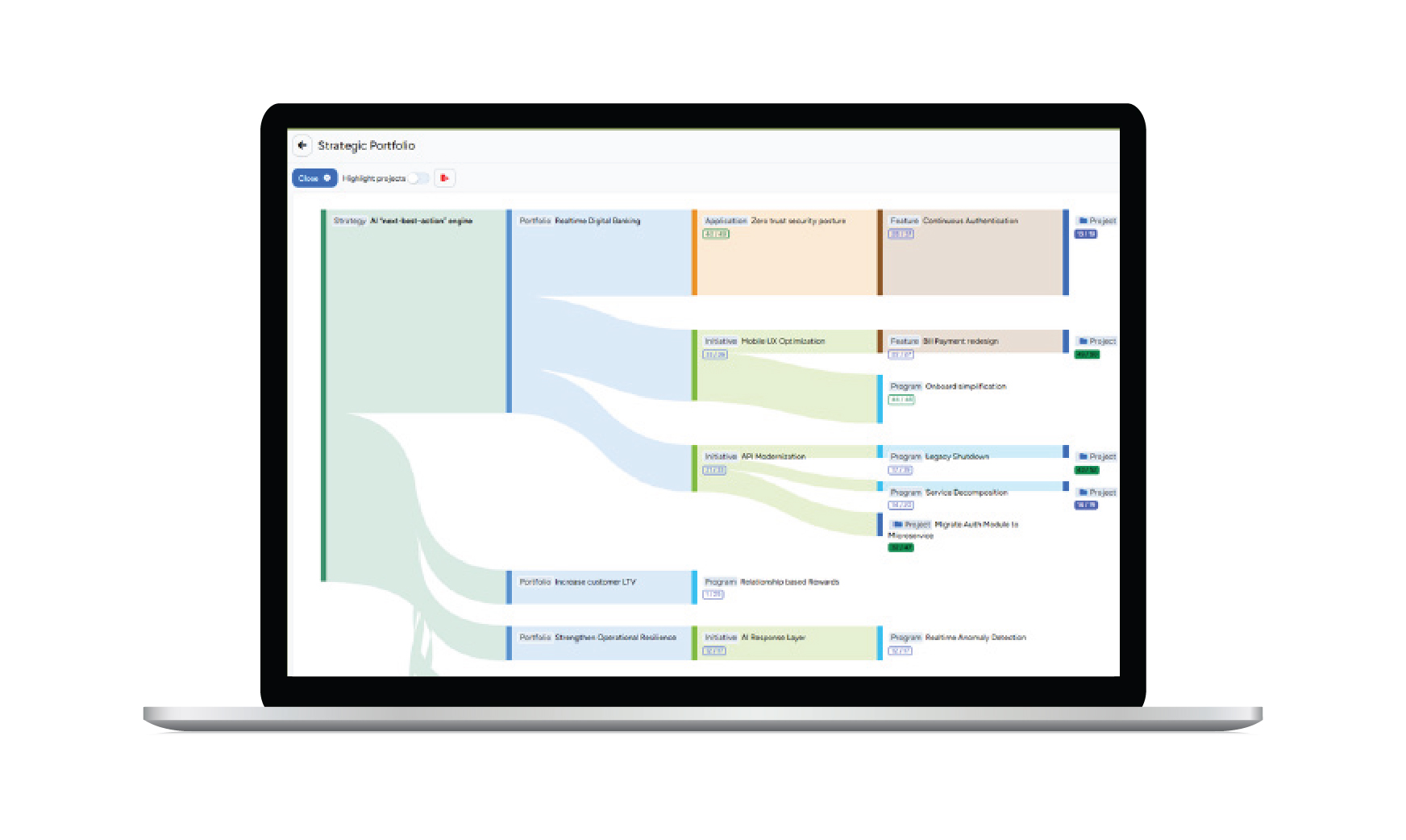
Centralizing your portfolio data isn’t a technology project. It’s a discipline. And it pays dividends that compound because once your data is clean, current, and in one place, you can start doing things that are impossible in a fragmented environment: modeling tradeoffs, running what-if scenarios, and presenting the portfolio as a strategic instrument rather than a collection of projects.
How to Centralize Portfolio Data for Decision-Making
Start by identifying your decision data. What questions do you get asked most frequently by leadership? “What’s our portfolio health?” “Where are we over-budget?” “Which initiatives are aligned to our top three strategic objectives?” Work backward from those questions to identify what data points you need and whether you have them, where they live, and how stale they typically are.
Then build a single portfolio view. This doesn’t have to be perfect on day one, but it needs to be authoritative. One place where project status, budget actuals, resource allocation, and strategic alignment scores live together. When the CFO asks for a portfolio budget summary, there is one number, not three depending on who you ask.
Reporting Recommendations: Portfolio Decision Dashboards
Your weekly executive-ready dashboard should give leadership an at-a-glance picture of what’s on track, at risk, and off track across the entire portfolio. At minimum, report on:
- Strategic alignment score what percentage of active investment is tied to approved strategic objectives? Anything below 70–80% is a conversation starter
- Portfolio health by program schedule, cost, and scope health in a single view, with red/amber/green status that’s updated weekly, not quarterly
- Investment distribution by theme how is the budget split across run/grow/transform or your strategic pillars?
- Top decisions required not a 40-row risk register, but the three to five things that require executive input this week
The Power of Scenario Modeling for Portfolio Tradeoffs
One of the most underused practices in project portfolio prioritization is tradeoff modeling. When an executive asks “what if we funded this new initiative mid-year?” you should be able to show them in minutes what moves off the roadmap, which resources get pulled, and what value is at risk.
That’s not just a useful analytical exercise; it’s how you move from being a reporting function to being a strategic partner. The PMO that can say “we ran three scenarios against that request and here’s our recommendation with the data to back it” is the PMO that earns a seat at the table.
Putting It Together: The PMO as a Capital Efficiency Engine
Capital efficiency isn’t about doing less with less. It’s about knowing, with confidence, that every dollar and every person in your portfolio is pointed at the outcomes that matter most to the business.
That requires three things working together:
- Value realization practices that close the loop between investment and outcome
- Resource forecasting that looks far enough ahead to act, not just react
- Centralized data and portfolio decision-making that gives leadership the visibility they need to lead
When you have all three in place, something shifts. You stop being the team that reports on what happened. You become the team that shapes what happens next.
That’s what strategic portfolio management, done well, actually looks like.
The Importance of Strategic Portfolio Management Software
Executing on these three disciplines at scale (value realization tracking, resource demand forecasting, and real-time portfolio dashboards) is what separates teams with a great process from teams with a repeatable capability. Strategic portfolio management software ties these practices together by connecting your initiative pipeline to your resource pool, attaching value drivers to every investment at intake, and surfacing the data your executive team needs without requiring a team of analysts to compile it. If your current toolset forces you to assemble portfolio truth from five different spreadsheets the night before a leadership review, that’s the gap worth closing.
