
Why Resource Management and Capacity Planning is Necessary
The guest on our latest podcast episode puts it simply: “Resource management is about matching the supply of people against the demand for their time so leadership can make accurate capacity decisions using real data and information, rather than just optimism.” Over more than two decades in and around IT, including more than 10 years leading PMOs in healthcare and education, our podcast guest Michael Kuzma has a wealth of knowledge to share about how PMOs should be set up, and what steps are crucial to take to ensure the PMO’s future success with resource management.
In this episode of What’s the Plan?, Michael, an enterprise PMO and strategic portfolio management leader, explains that when done successfully, resource management and capacity planning are able to provide data-backed answers to:
- Can we take on another project?
- When can the initiative realistically begin?
- What are the bottlenecks in our organization?
- What happens to everything else if the new, very important, top priority project becomes the thing that has to overtake everything else?
Resource management and capacity planning seek to understand what the workload is, and to make transparent the amount of time those resources have available for actual project work.
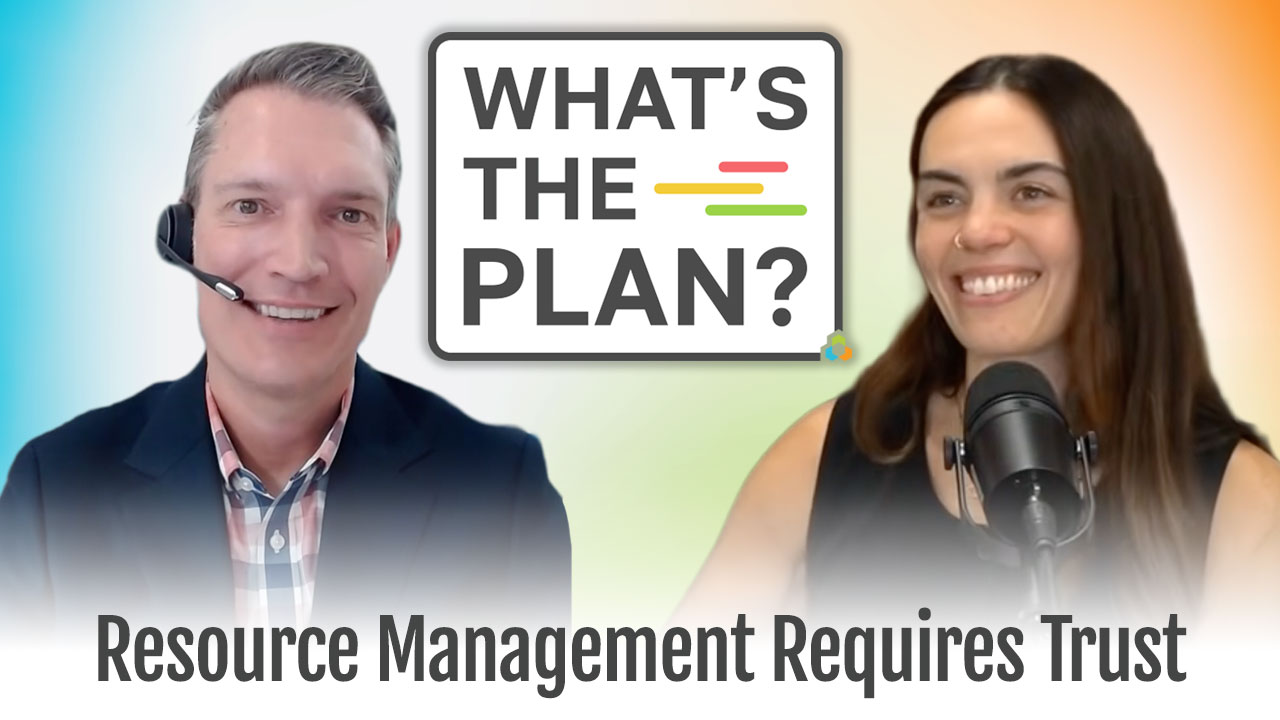
Why Resource Management Requires Trust
The relationship between a PMO and leadership is key to resource management and capacity planning success. Those resource management questions above are some of the first questions that leadership will ask from a PMO, but getting to those answers first requires a lot of steps to lay the groundwork. PMOs need to be good at a lot of tasks, from creating accurate estimates for work duration, understanding your resources’ skillsets, and creating a process for demand management. Michael explains that having trust between the PMO and executive leadership – in both directions – is key. First, resource managers need to trust that if they do all these tasks and keep resource management up to date, that leadership will make changes and accept their recommendations once problems are uncovered. On the flip side, leadership must trust that resource managers aren’t being defensive in numbers that they provide or protect their team artificially from more work. It takes time to build this trust. While all the steps to create a resource management process are important, lacking that mutual trust between the PMO and leadership is the only precondition that can invalidate everything else.
Issues With Leadership and Friction Surrounding PMOs
Michael talks about the cultural tendency for PMOs to want to say “yes” to executive leadership when a new priority or project is requested. No one wants to deny an executive the outcomes that they are seeking from a project request by saying, “we can’t do this right now.” However, without data, the PMO is in a very difficult position to turn down work, or state that a project cannot start right away. By contrast, when you have data, you can support your recommendations to delay a project’s start date or share the tradeoffs with adding a new strategic goal to the portfolio and what might need to be deprioritized.
Timesheets can also create unnecessary strife between the PMO and leadership. While PMOs are likely used to push back from employees about being accurate and honest when implementing their time, timesheets provide a very clear picture about how resources spend their days, and it can expose situations where resources are over-allocated or under-allocated. If timesheets become a tool for performance evaluations, it can hamper the efforts of the PMO to ensure employees are entering time accurately for better project estimates and resource planning. It won’t help if over-allocated resources feel like they might be perceived as being too slow, when the reality is that they are experiencing burnout from being inundated with work. Likewise, employees who appear under-allocated could be spending a larger chunk of time on internal items like team meetings and training, and do not want to appear like they aren’t accomplishing their work.
Michael’s Nine Sub-Processes that Comprise the Resource Management Process
Michael has written extensively about mastering strategic portfolio management, and has nine sub-processes that comprise resource management and capacity planning:
- Managing Resource Roles: your demand management process looking to attach roles to a project
- Managing Resource Records: ensuring every resource has a file of basic information, ideally syncing with your HR’s system
- Managing Resource Timesheets: gathering data on resource utilization, project duration, and the foundations for your future planning
- Managing Resource Demand: estimating the amount of time that a resource or role needs to be on a project
- Managing Resource Supply: the forecast of how much each resource and each role is available over time
- Managing Skills Matrices: seeing resource capabilities; the onus for this step is on individual resources to help manage and update
- Reporting on Actuals and Bottlenecks: while actuals deal with historical data based on timesheets, bottlenecks are about forecasts and knowing what overallocations are coming in the future
- Performing What-If Analysis: this dives into what executive leadership truly wants, what Michael calls the “holy grail or portfolio governance and resource management”
- Managing Workload Balancing: if someone is working 60+ hour weeks, and another employee is underutilized, are you able to shift work from one resource to the other?
To learn more about how to build trust between PMOs and executive leadership, and the preconditions you can test for before attempting resource management and capacity planning in your organization, listen to our latest episode of What’s the Plan?.
Check out the full episode here: https://www.prosymmetry.com/podcasts/e9-title-resource-management-requires-trust-building-a-process-that-works.
Don’t miss his article series, Mastering Strategic Portfolio Management, available on Michael’s LinkedIn page.
For more insightful conversations about real-world conversations about all things project management, resource forecasting, capacity planning and more, subscribe to What’s the Plan? Episodes are available on:
Episode Frequently Asked Questions
What is the value of resource management and capacity planning?
Resource management and capacity planning are about getting the right people to the right projects at the right time. To do that, you need to understand every resource’s skills, experience and capacity, know what the work requires of resources, understand current and future demand, and what else is already on your resources’ plates. Resource management and capacity planning seek to understand what the workload is, and to make transparent the amount of time those resources have available for actual project work.
Why does resource management require trust, and who is that trust between?
The relationship between a PMO and leadership is key to resource management and capacity planning success. Having trust between the PMO and executive leadership is key, and the trust needs to be mutual.
What are the steps that a PMO can take to create a resource management solution?
There are nine sub-processes that a PMO must create to execute successful resource management and capacity planning, ranging from understanding resource roles and skills, collecting resources’ timesheets, creating a demand management system and being able to plan for work with accurate time estimates for projects.
