
With more than 1,700 staff at 19 sites across Australia and New Zealand, Airbus Group Australia Pacific assembles and delivers 47 MRH90 multi-role helicopters for the Australian Army and Navy and also provides the military with support for 22 Tiger ARH armed reconnaissance helicopters.
The firm delivers new Airbus Helicopters machines and maintains more than 500 aircraft through a network of local facilities. In addition to its helicopter capabilities, Airbus Group Australia Pacific maintains the Royal Australian Air Force’s (RAAF) AP-3C Orion reconnaissance aircraft and C-130J Hercules transports. Through the work of subsidiary Safe Air, the Group supports the Royal New Zealand Air Force’s C-130s and P3s while being recognized as a leader in propeller and engine maintenance.
Michael Choudhury, Business Solutions Manager at Airbus Group Australia Pacific, and his teams are responsible for the development and support of all applications deployed by the various businesses of Airbus in Australia and New Zealand. His extended team is made up of both onshore and offshore resources and consists of 50 members. In charge of organizing and managing the spread of resources across the Pacific region as well as his team’s tasks and goals.
The company was using lots of different pieces of software and ways of managing things on different sites and that instead of helping manage resources and timelines, made things more confused, as Michael explains:
“There are a large number of projects in flight at any given time across several technology domains such as SAP, Dassault Systems, PHP and .NET-based applications, artificial intelligence, and data products,” says Michael. “That often means that there is a lot of work to be done just trying to keep up with all the various functions that make up the projects.”
The complexity of using all these different tools was compounded by geography too. “Because we work across a large geographical area and our resources exist both onshore and offshore, a higher level of organization, collaboration and communication are vital for us to do our jobs well—meaning completing projects on time, and to budget.”
A lack of visibility of the firm’s resources, both in terms of geography, but also in terms of the tools being used, was harming project progress. Airbus Group Australia Pacific was coming to realize that resources and projects were incorrectly utilized. They wanted something that would help them get greater visibility and do things even better, by cutting waste, support customers better, and by proxy, boosting communication and collaboration.
A big part of the resource management Airbus Group Australia Pacific does is about maintenance. Michael needs to view how resources are being used in all projects, but also wants to see how individuals are doing their jobs and plan their time better. For instance, he might want to view how one engineer is doing and realize that they are currently underutilized and this is wasting time and money, and he can then reallocate them to more projects.
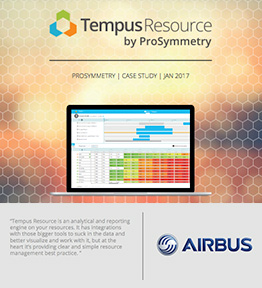
Michael expands on this: “the Tempus resourcing tool helps our business stay ahead of the game by providing our resource planners the ability to turn their forecasts ‘on a dime’ with constantly evolving operational needs.” He goes on, “Its dynamic reporting capabilities are a major benefit, too—being able to view analytics for all our projects and resources, as well as track individual resource performance, means we can make much more informed decisions that positively affect individual projects and ultimately make our business better.”
Inherent in this was the solution to another problem for Airbus, which as Michael points out, “was to optimize the use of resources.” Every business wants to make the most of what they have, but for a company like Airbus, the building of Helicopters and other aircraft is a massive undertaking with large but tight budgets and strict timelines to oversee. A lot of their business is done with military organizations. Unsurprisingly, precision and deadlines are crucial—the ability provided by Tempus Resource to help them stay ahead of the game, as Michael says, was one of the greatest benefits.
For Michael, finding a tool that would have a high user adoption rate was key. A lot of resource management solutions come as part of a broader PPM tool and consequently can be clunky and difficult to use. As he explains, Tempus Resource was just what he was looking for. “The key challenge for us was to improve user adoption of the applications that we deploy. One step to doing that was rolling out Tempus Resource. Its user interface is so simple and intuitive that end-user adoption has been quicker than any other solution we’ve used for similar purposes.”
Airbus Group Australia Pacific are currently exploring the possibility of rolling out Tempus Resource to all their other sites and programs during 2017. Thanks to the support from Pro Symmetry, Michael believes they are in good hands. “The support provided during the planning of the roll-out and the actual implementation was exemplary. Post go-live support is also excellent despite obvious time-zone differences,” he says.
Tempus Resource, by ProSymmetry, is a leading resource planning and ‘what-if’ modeling tool. Named a Gartner 2016 PPM Cool Vendor for Resource Planning, Tempus Resource offers innovative capabilities for companies managing anything from 50-20,000 resources. Tempus Resource delivers an Excel-like interface, with further integration for many other PPM or other internal systems. ProSymmetry offer a number of innovative Project and Portfolio Management tools, and is a Microsoft and Nintex Partner.
Contact ProSymmetry for a free Tempus Resource trial or demo.

© 2026 ProSymmetry. All Rights Reserved.
ProSymmetry, Tempus Portfolio and Tempus Resource are registered trademarks of ProSymmetry LLC.