

Business leaders and Resource Managers must continuously align their organization’s strategy, planning and execution with constantly changing availability and workload of employees, business goals, and other outside factors. Part of this alignment involves deciding how much to focus on the lofty goals and visionary ideas that can revolutionize a business, versus the daily needs to run a business. Those decisions about priorities also must consider employees’ workload and future availability, how much room is in the budget to achieve these goals, and deadlines.
In this guide, we’re going to talk about resource management – what it means, why you need resource management, how resource management fits with project management and implementing strategy for your business, and a how to use a resource management maturity model so you can best understand where your organization currently stands and how you can take steps to adapt and grow.

What is Resource Management?
Our ability to finish projects and accomplish our goals is fundamentally determined by having qualified people. Without people, we can’t do work, execute projects, or implement strategy. Resource management helps us most effectively utilize our people to achieve our business goals. Resource management helps match our supply of people (resource capacity) with our demand for people (resource allocation).
Task-oriented planning is great, but without understanding the near-, mid- and long-term impact on key skills, roles and individuals, even the best plans are destined to fail. Resource management is the foundation of project delivery and strategy execution. Whether your goal is to innovate, drive transformation, or improve profitability in record time, your teams must become efficient practitioners of resource management to experience portfolio success. To do so, you need a specialized solution designed with Resource Managers in mind.
Check out our video, What is Resource Management?

Why Do You Need Resource Management?
Without effective resource management, most organizations find themselves struggling to optimize or even maintain a strong project portfolio or achieve their strategic goals. Issues arising from budget constraints, deadlines and employee availability can get in the way of getting the job done.
For too long, organizations have failed to effectively manage the connection of resources and strategy – impacting their ability to create a sustainable competitive advantage. While this often manifests as a failure to deliver on a particular project, the unfortunate truth is that the longer-term effects negatively impact an organization’s ability to innovate, transform, and be profitable.
Check out our video, Why Do You Need Resource Management?

Is Resource Management the Same as Strategic Portfolio Management or Project Portfolio Management?
Resource management differs, but aligns with Strategic Portfolio Management, which is the process of creating a strategy for the entire business and building the supporting projects, products, roadmaps and plans to execute that strategy. Strategic Portfolio Management is designed to produce an executable plan. It’s not just about the strategy and important decisions, but also whether and how the work gets done. It’s the portfolio of work that will help your business achieve that strategy’s goals. Resource management helps business strategy reach the finish line. While Strategic Portfolio Management sets up the focus and strategy well, RM helps execute the strategy with the right people, with the necessary skills, using the correct plan via effective business processes.
While many consider resource management and Project Portfolio Management (PPM) similar, what sets them apart is critically important for successful project management. Most PPM tools focus largely on the tasks required to execute a project. While PPM may consider multiple projects, it is still structured to evaluate projects based on their individual requirements as opposed to how those requirements could create conflict across other projects in your portfolio. Resource management takes a holistic view of the entire project portfolio by broadening the planning horizon beyond task-based assignments and focusing instead on how resources are being allocated and utilized throughout the organization, incorporating workload into the planning process. Project managers need to bridge resource management together with capacity planning. Capacity planning looks at the big picture of whether an organization has the person capacity and skill sets required to fulfill the future demand of programs and projects. This is typically a strategic planning process that looks months or years ahead, taking time, skills, and demand into consideration.
The best solution for resource management and capacity planning need to have:
- Resource capacity planning tools
- Project forecasting
- What If analysis
- Time tracking
- Customizable reporting
- Skills management

What Comes First: Resource Management or Project Management?
Projects are driven by your portfolio, which is really driven by a company’s vision and goals. Resource Managers need to balance the needs of your employees with those strategic goals.
Check out our video, What Comes First: Resource Management or Project Management?

How to Implement a Resource Management Strategy
It’s important to note that any resource management strategy requires having a strong resource management solution already in place. Too often, Resource Managers rely on tools – typically project management software – that force them into a strait jacket of project planning. These tools shift your focus to tasks and task relationships – the sequencing of steps and Work Breakdown structures – not on the most critical, expensive, and limited quantity asset essential to the success of your project and strategy: resources. Without a focus on resources, these software solutions overcomplicate the process and often fall apart when they clash with the real-world requirements of resource management. In other cases, resource planning is managed in a tangled web of spreadsheets. We are all too familiar with management by spreadsheet and its pitfalls. Not only is the process virtually guaranteed to end in frustration and even more spreadsheets, but the results are also the same – zero insight into the alignment of resources, strategy and business.
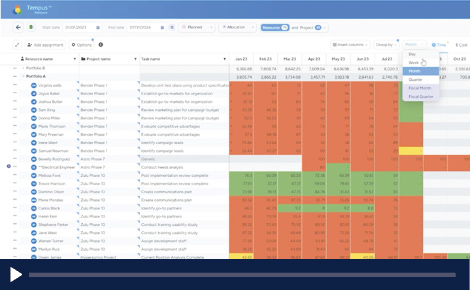 With the right platform in place, your organization can begin the comprehensive planning process to better utilize resource capabilities. To learn more about why using spreadsheets is risky for resource management, watch our webinar.
 Why Do Projects Fail? Read about some of the most common mistakes and how to avoid them.

Resource Management Maturity Model
If resource management helps us effectively utilize our people to achieve our business goals, then there are natural stages to how this is achieved. For some organizations, it starts with simply looking ahead to how employees can be better assigned to projects that maximize their job skills and don’t overwork them. For more advanced teams, that can involve more proactive analysis of roles, responsibilities and projects 18 months to two years out for better resource forecasting and capacity planning. By following a resource management Maturity Model, you can assess where your organization falls in its use of true resource management, not just Project Management. You can also follow some clear steps to move your efforts forward and evolve into a more mature organization.

Level 1: “Fire Drill” Resource Planning
“My project is approved, and tasks have been assigned, what could go wrong?”
What This Looks Like
Project approved? Great! Let’s start today. In Level 1 organizations, resource planning happens after the fact – if it happens at all. Project managers grab whoever seems available (or whoever they like working with), and resource conflicts are discovered when someone inevitably says “wait, I thought Sarah was working on my project.”

The Daily Reality

Monday morning panic: “Who’s actually working on the Q3 launch?”

The favorite person problem: Your best developers are on every project plan

Excel archaeology: Digging through multiple spreadsheets to figure out who’s supposed to be where

Surprise conflicts: Finding out about resource clashes during project status meetings
Business Impact
- Projects start without clear staffing plans
- Resource conflicts cause last-minute scrambles and project delays
- Team burnout from unclear workload distribution
- Missed opportunities because you can’t confidently commit to new work
Success Metrics at This Level
- Project success is measured by “did we eventually deliver something?”
- Resource conflicts cause last-minute scrambles and project delays
- Team satisfaction varies wildly based on workload luck

Level 2: “Spreadsheet Sophistication”
“We have a system… it’s called Excel”
What This Looks Like
You’ve graduated to more organization but, the chaos still persists. Resource managers now have a say in assignments, and there might even be formal meetings about who’s working on what. The hallmark of Level 2 is the emergence of “The Master Spreadsheet” – that one Excel file everyone’s afraid to touch but desperately needs.

The Daily Reality

The monthly resource meeting: An hour of “Sarah’s booked until Q3, but maybe we can shift Tom from Project B…”

Version control nightmares: “Are you looking at ResourcePlan_v12_final_FINAL.xlsx?”

The skills guessing game: “I think Mike knows React, but let me check with his last project manager”

Capacity calculations: Manual math that everyone hopes is right
Business Impact
- Better visibility than Level 1, but still reactive
- Resource conflicts are caught earlier, but solutions are limited
- Skills and experience aren’t systematically leveraged
- Planning beyond current projects is difficult
Success Metrics at This Level
- Fewer last-minute resource surprises
- Some basic utilization tracking
- Project managers and resource managers communicate somewhat regularly

Level 3: “Getting Serious”
“We have a real system now that provides real insights”
What This Looks Like
The business has officially outgrown Excel (hallelujah!) and invested in proper resource management tools. You can finally see everyone’s capacity and current commitments in one place. Resource managers can spot over-allocation before it becomes a crisis, and project managers can make more informed staffing decisions.

The Daily Reality

Capacity planning: “Based on current commitments, we can start the new project in 6 weeks”

Team Resource orchestration: “Our Agile teams need two more developers for the mobile sprint, and we can pull them from the waterfall ERP project between phases”

What-if scenarios: “If we hired two more architects we could deliver this 3 months earlier”

Real utilization data: Finally knowing if your team is actually overloaded or just complaining
Business Impact
- Projects start with clear resource plans
- 3-12 month planning becomes possible
- Resource conflicts are prevented, not just managed
Success Metrics at This Level
- Improved project success rates
- Better resource utilization (without burnout)
- Faster project staffing decisions
- Reduced resource-related delays
- Resources flow seamlessly between waterfall phases and agile sprints based on business priorities

Level 4: “Strategic Resource Orchestration”
“Our resource plan drives our business strategy”
What This Looks Like
Resource planning is now part of strategic planning. Before any project gets approved, the resource requirements are understood and validated. Portfolio managers, project managers, and resource managers work together to ensure the organization is taking on work it can actually deliver.

The Daily Reality

Skills-based assignments: “We need someone with React experience – oh look, Sarah and Mike both qualify and Sarah’s available”

Strategy sessions that include resources: “This roadmap looks great, but do we have the expertise to deliver it?”

Integrated planning: Project timelines are based on actual resource availability, not wishful thinking

Long-term forecasting: “If we want to enter the mobile market next year, we need to start hiring iOS developers now”

Data-driven decisions: “Based on our utilization patterns, we should invest in automation tools”
Business Impact
- Strategy and execution are aligned through resource reality
- Projects have higher success rates because they’re properly staffed from the start
- Competitive advantage through better execution predictability
- Proactive capability upskilling rather than reactive hiring
Success Metrics at This Level
- High project success rates (80%+ on time, on budget)
- Strategic initiatives are delivered as planned
- Resource utilization optimized for sustainability (75-80%)
- Predictable project delivery timelines
- Real visibility into the work, the skills required and the skills your people have

Level 5: “Resource Management as Competitive Advantage”
“Our strategy is credible because we have the people and plan to execute it”
What This Looks Like
Resource management has evolved into a formal Resource Management Office (RMO) that connects company vision and strategic goals directly to project execution capabilities. The RMO provides executive leadership with confidence that strategic initiatives aren’t just aspirational slide decks – they’re executable plans backed by real resource commitments and capability development. For some, an RMO may not be an official department, it may be an executive-level commitment that Resource Managers have a seat at every table.

The Daily Reality

Vision-to-execution mapping: “Our 3-year vision requires these 12 strategic initiatives, supported by these 47 projects, and here’s exactly how we’ll staff them”

Strategic confidence validation: “Yes, we can commit to that market expansion timeline – here’s the resource plan that proves it”

Skill gap analysis: “To achieve our strategic goals, we need to train these capabilities by Q2 next year, and here’s our development plan”

Strategic target accountability: “Our strategic goals are realistic because we have the resource plan to deliver the projects that support them”

Execution confidence: We can present strategy knowing it’s backed by executable resource commitments, not wishful thinking
Business Impact
- Strategic planning sessions produce executable plans, not just aspirational goals
- Executive leadership has confidence in strategic commitments to board, investors, and market
- Organization consistently delivers on strategic promises because resource reality is built into the planning
- Strategic pivots are possible because leadership understands true execution capacity
- Competitive advantage through reliable strategic execution
Success Metrics at This Level
- Strategic initiatives consistently deliver on promised timelines and outcomes
- Executive leadership confidence in strategic commitments
- Board/investor confidence in organization’s execution capability
- Market recognition as an organization that delivers what it promises
- Strategic goals are achieved year over year because they’re resourced appropriately

Additional Resources

For those looking for tips to help you implement your organization’s resource management strategy and excel as a Resource Manager, read our Guide to Developing Skills as a Resource Manager.

To learn more about how to balance resources and strategy within your organization, read our Guide to Strategic Portfolio Management and Resource Management.
Visit our YouTube channel for helpful tutorials about many resource management topics including creating a resource utilization rate, how to transition from spreadsheets to a resource management platform, and how best to harness modeling and scenario planning.

To learn more about why a resource management platform is essential for your organization and what pitfalls your business may experience without one, read our Buyer’s Guide to Resource Management.